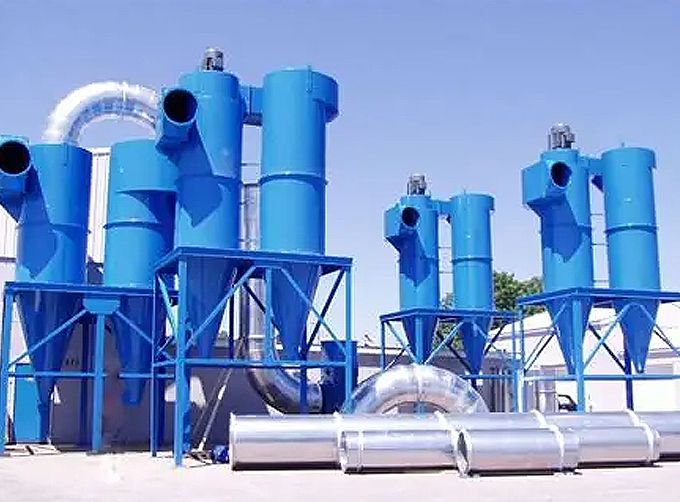
Cyclone Separator — High-Efficiency Gas-Solid / Gas-Liquid Separation Equipment Product Overview The Cyclone Separator is a highly efficient separation device that uses centrifugal force to remove solid particles or liquid droplets from a gas stream. The particle-laden gas enters the system tangentially at high velocity, creating an intense spiral motion within the conical chamber. Under the influence of centrifugal force, particles or droplets are thrown against the wall and slide down into t
The Cyclone Separator is a highly efficient separation device that uses centrifugal force to remove solid particles or liquid droplets from a gas stream. The particle-laden gas enters the system tangentially at high velocity, creating an intense spiral motion within the conical chamber. Under the influence of centrifugal force, particles or droplets are thrown against the wall and slide down into the collection hopper, while the cleaned gas is discharged upward through the central outlet pipe. Widely applied in chemical processing, environmental protection, food manufacturing, pharmaceuticals, metallurgy, and energy sectors, the cyclone separator is a core solution for industrial dust control and material recovery.
Dust- or droplet-laden gas enters the cyclone tangentially through the inlet, forming a high-speed outer vortex inside the cylindrical and conical body. Suspended particles or droplets, being much denser than the carrier gas, are thrown outward against the wall, lose their kinetic energy, and slide down into the discharge hopper or liquid collection chamber. The cleaned gas then reverses direction near the cone bottom, forming an inner vortex that moves upward and exits through the central outlet pipe. The device has a simple construction with no moving parts and can operate stably and continuously under high temperature, high pressure, and highly corrosive conditions.
Tangential Inlet: A tangential or volute-type entry that guides the particle-laden gas into the separation chamber at an optimal velocity to create a stable vortex flow field.
Cylindrical and Conical Body: The cylindrical section provides the initial rotational space, while the tapered conical section gradually reduces the cross-sectional area, increasing rotational speed and enhancing centrifugal separation. The cone angle is precisely designed based on particle characteristics.
Central Outlet Pipe (Vortex Finder): Positioned at the top center to extract the cleaned gas from the core of the inner vortex. The length of the vortex finder is a critical factor affecting separation efficiency.
Collection Hopper / Liquid Receiver: Collects the separated solids or liquid, commonly equipped with an airlock discharge valve or a liquid draining system to allow continuous discharge without disrupting the internal flow field.
Wear- and Corrosion-Resistant Lining: For highly abrasive or corrosive materials, wear-resistant ceramics, cast stone, or specialized coatings can be applied to the inner wall, substantially extending the service life of the equipment.
Extremely Simple Structure: With zero moving parts, the cyclone separator offers a compact design, low manufacturing and maintenance costs, and exceptionally high reliability.
Exceptional Adaptability: Capable of handling high temperatures (above 1000°C), high pressures, high dust loadings, and corrosive media by selecting appropriate materials for demanding conditions.
High Separation Efficiency: Achieves typical efficiencies of 95%–99% for particles larger than 5–10 μm, with moderate pressure drop.
Continuous Operation: Discharge options support continuous particle or liquid removal without process interruption, meeting the demands of large-scale continuous production.
Flexible Multi-Stage Configuration: Can be deployed as single units or multi-stage parallel/series arrays, as well as combined with baghouse filters, scrubbers, or other equipment to achieve ultra-clean emission levels.
Gas Flow Capacity 100–50,000 m³/h (larger sizes available on request)
Cut Particle Size 5–10 μm and above
Separation Efficiency 95%–99% (depending on particle size and density)
Pressure Drop 500–1500 Pa
Inlet Gas Velocity 15–25 m/s (standard design)
Material of Carbon steel, SS304/316L, Duplex Stainless Construction Steel, ceramic / cast stone lined, etc.
Operating Temperature -20–450 °C (special designs for >1000°C available)
Discharge Method Manual / automatic discharge valve, continuous liquid draining




 1464791908@qq.com

 +86 13832176953